Choosing your photographer is one of the most important decisions you’ll make for your senior portraits.
At Humke Group, we have a very specific look and style — and we believe every photographer worth hiring does too. Here’s the framework we use to evaluate what makes a photographer truly exceptional, and what you should be asking before you ever book a session.
Style & Consistency
Every photographer worth hiring has a distinct, unmistakable aesthetic. Before you book anyone, ask yourself: do I genuinely love their work? Not just one image — their whole body of work.
And here’s the part most people skip: ask to see a complete session from beginning to end. A carefully curated portfolio shows their best ten frames. A full shoot reveals the truth. Do the images hold up from the first shot to the last? Is quality consistent, or just occasional? That’s what you need to know.
Knowledge & Training
Photography is a technical craft. The difference between a memorable portrait and a forgettable snapshot often comes down to whether your photographer understands the fundamentals — truly understands them, not just approximately.
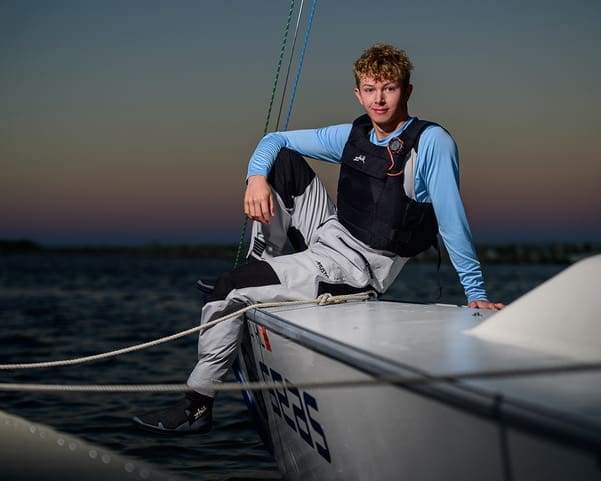
Horizon line placement. In a full-body shot, where the horizon falls in the frame matters enormously. A knowledgeable photographer places it deliberately — never cutting through the subject at an unflattering point.
Eye catchlight. That small reflection of light in the eye is what makes a portrait feel alive. Knowing how to create it, position it, and control it takes real skill.
Eyes in focus, always. Regardless of creative intent, depth of field, or artistic style — the eyes must be tack sharp. No exceptions. This is the single most important technical rule in portrait photography.
Posing with intention. Posing a real person is an art. Great posing is invisible — it looks effortless and natural. Bad posing announces itself immediately. This takes training and repetition to master.
Gear & Preparation
Professional equipment isn’t about prestige — it’s about reliability and capability. Ask your photographer what they’re bringing to your session.
A backup camera body. This is non-negotiable. Cameras fail. A professional photographer always arrives with a second body. If they don’t, they’re gambling with your once-in-a-lifetime session.
Portrait lenses (85mm and above). A true portrait lens — 85mm, 105mm, 135mm — renders the face with the flattering compression that shorter focal lengths simply cannot achieve. If your photographer only owns a zoom kit lens, that’s a red flag.
Wide lenses for creative variety. Environmental portraits, storytelling compositions, and creative context shots all benefit from a quality wide-angle. Variety in a gallery requires variety in glass.
Long telephoto for facial compression. Shooting at 200mm or beyond creates a beautiful, flattering compression of facial features that is remarkably kind to every face. It’s one of the most under-discussed tools in portrait photography.
“The right photographer brings skill, preparation, and intention to every frame — and it shows in every single image they deliver.”
Editing & Post-Production
Straight-out-of-camera images are a raw ingredient, not a finished product. What a photographer does in post-production reveals just as much about their skill as how they shoot.
Color correction and grading. Professional color work sets the mood, ensures accurate skin tones, and creates a cohesive look across the entire gallery. If they hand you JPEGs without any color work, that’s not a final product.
Geometric corrections. Are images straightened? Are converging verticals corrected — those lines on buildings and walls that lean inward from lens distortion? Small things, big difference.
Retouching: AI vs. by hand. Know what you’re getting. AI tools are fast, but hand-edited images carry intention and care. There’s a difference — and a good photographer can explain it.
Frequency separation vs. skin smoothing filters. Frequency separation is the professional standard: it removes blemishes while preserving the natural texture of skin. A blanket skin-softening filter makes everyone look like plastic. Ask which method they use.
Heirloom Products vs. Digital Files
Receiving a gallery of digital files sounds wonderful — until those files sit untouched on a USB drive in a drawer for twenty years.
A digital file is not an heirloom. An album is. A beautifully printed wall portrait is.
Before assuming digitals are the goal, ask yourself honestly: do you know how to get a digital image professionally printed and framed? Do you know that an 8×10 and a 4×6 have different aspect ratios — and that simply cropping one to the other will cut off parts of the image? Do you have a plan for these files beyond “someday”?
Albums. A professionally designed, lay-flat album tells the story of your session from beginning to end. It lives on a coffee table, it gets opened, it gets shown. That’s the point.
Wall art. A portrait printed on fine art paper or canvas, mounted and framed, is seen every single day. It becomes part of your home. It is the investment that compounds for a lifetime.
Look for a photographer who offers these products and guides you through the process. The best photographers are invested in the final result, not just the shutter click.
On Price
We’ll be direct: price should not be a deciding factor for a once-in-a-lifetime session.
Senior portraits happen once. There is no do-over. No second chance at this exact season of life, this face at this age, this moment. The old adage — you get what you pay for — has never been more true than in photography.
The photographer who charges less may cost you the images you’ll wish you had for the rest of your life. The right photographer is an investment. Not in the session — in the heirlooms that will hang on your wall for decades and the album your children will flip through long after the session is a memory.
Invest accordingly.
At Humke Group, we hold ourselves to every standard on this list — and we invite you to hold us to it too.


